

How to Obtain an Ecuador Retirement Visa
UPDATED May 1, 2022
A growing number of Americans are retiring in Ecuador to take advantage of affordable living costs, a warm equatorial climate, and diverse cultural and natural attractions.
While Ecuador has its fair share of problems dealing with poverty and has yet to achieve success to industrialize its economy and provide a strong base of middle-class job opportunities for its citizens, this is a country that is rich in resources and has plenty of cities and towns with sufficient infrastructure, medical facilities, and an educated populace to make this a comfortable place to live for Americans seeking a new life or a second home. And of course, living costs are significantly lower in Ecuador. Most retirees can live comfortably on $25,000 a year – much less than the average living costs in countries like the United States or Canada.
The Ecuadorian cost of living runs about 45% less than average expense in the U.S., according to Numbeo (https://www.numbeo.com/cost-of-living/country_result.jsp?country=Ecuador). Rents are also about 72% less, Numbeo found. Apartment rentals in the popular retirement center of Cuenca can be found through such expat-oriented websites as https://gringopost.com and https://cuencahighlife.com. Retirees can also buy property in popular retiree hotspots such as Manta, as shown at https://www.ecuadorshoresrealty.com.
Expat retirees have the same rights as Ecuador citizens do, including several money-saving benefits. Senior citizens pay lower taxes; receive less expensive healthcare; get 50% off airfare, private, and public transportation; receive free local landline phone service; and enjoy discounts ranging from water and electric bills and tickets for sporting and cultural events.
In 2019, two million tourists visited Ecuador. Several international airports serve the country, with the main ports of entry for American visitors being Quito (Mariscal Sucre International Airport), which has direct flights from Miami, Fort Lauderdale, Atlanta, and Houston, and Guayaquil (José Joaquín de Olmedo International Airport), which has direct flights from Miami, Fort Lauderdale, and New York (JFK). Ecuador uses the U.S. dollar, so currency conversion is straight-forward for newcomers. This also makes the country’s economy more stable compared to other Latin American nations, who generally have a poor track record of managing their own currencies. Most of Ecuador is in the Central Time Zone, with another portion on Mountain Time, making it easy to keep up with family or business contacts back home.
The majority of Ecuador lies within humid tropical rainforests along the equator. The remainder includes the Andes Mountains, the Pacific Ocean coastline, and the Galapagos Islands. The capital city of Quito is categorized as subtropical highlands, while other regions vary from coastal lowlands to mountain glaciers.
Quito, founded in the 1500s on the ruins of an Inca city, contains the best-preserved historic center in Latin America. UNESCO named the city’s historic center as one of its first two World Cultural Heritage Sites in 1978. The district is known for its Spanish churches and the monasteries of San Francisco and Santo Domingo. Parque Metropolitano Guanguiltagua, the largest urban park in South America, is twice the size of New York’s Central Park. Quito’s TeleferiQo aerial tramway takes visitors from downtown to the cool slopes of the Pichincha volcano for hiking and sightseeing.
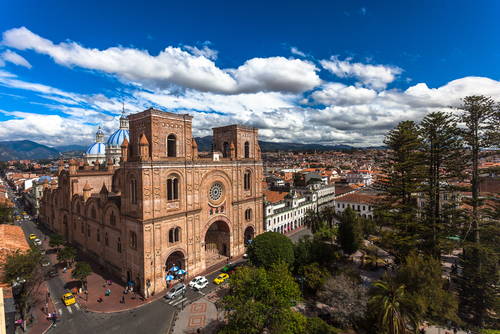
Many retirees tend to favor the smaller cities and towns of Ecuador. The best-known retirement city is Cuenca in the Ecuadorian highlands. Also a World Heritage Site, Cuenca features historic cathedrals, monasteries, museums, and Incan ruins. With a population of around 650,000 residents, Cuenca is the perfect size. The city is big enough to have a wide variety of restaurants, cafés, shopping, medical facilities, and cultural events throughout the year, yet small enough to maintain a cozy and welcoming environment that steers clear of big city issues like pollution and violent crime found in certain parts of Guayaquil and Quito. Cuenca has one of the most beautiful and historic city centers in Latin America, but also has modern conveniences such as shopping malls and grocery stores that will make American visitors feel at home.
Loja, also located in the Andes highlands about a 3 ½ hour drive south of Cuenca, is considered the artistic and musical capital of the country. Similar to Cuenca, Loja also has a charming downtown with beautiful colonial architecture. While the city lacks the “expat vibe” and the amenities found in Cuenca, it is certainly a town worth exploring as a potential retirement destination. American retirees and long-term visitors also flock to the nearby village of Vilcabamba, which is only about a 45-minute taxi ride from Loja. Vilcabamba has long-been a popular destination for backpackers, outdoor enthusiasts, and counterculture types, but in recent years it has become a legitimate destination for American retirees seeking to build their dream retirement home. The natural beauty of the area and year-round perfect weather make Vilcabamba an idyllic spot for anyone dreaming of a laid-back, carefree lifestyle “South of the Border”.
For those who dream of living by the ocean, the 530–mile long Ruta del Sol coast offers surfing, diving, sunbathing, fishing, and boating. Salinas is the best-known beach resort in the country for local Ecuadorians and has several new high-rise condominium projects overlooking the ocean such as Perlazul, giving this beach town a cosmopolitan feel similar to that of South Florida. Playas has grown from a small fishing village to a leading vacation destination. Manta, the third-largest city in Ecuador, is a busy commercial fishing port with a strong expat community. Other popular beach cities include fast-growing Santa Marianita; laid-back Ayangue; backpacker and surfer favorite Canoa; whale-watching site at Puerto Lopez; and Ayampe, home to a network of rainforest trails. The best-known Ecuadorian destination for tourists is the Galapagos Islands, famous for the unique and diverse wildlife that inspired Charles Darwin’s theory of evolution through natural selection.
Ecuador Retirement Visa Qualifications and Documentation
Ecuador offers 13 residential visa options, but the most popular choice for foreign citizens living in the country is the 60-III Pensioner’s program. The retirement visa program is available to U.S. citizens ages 65 years and up. The temporary retirement visa is good for two years and can be renewed indefinitely – or converted to a permanent residency visa if so desired. The main requirement is proof of a pension of at least $1275 per month (plus another $250 monthly for each dependent accompanying you). You do not necessarily need to be retired, but you will need to provide proof of a guaranteed income for the remainder of your life.
The Republic of Ecuador does not require a visa for tourist travel from the United States to Ecuador. All you need to enter the country is a U.S. passport valid for at least the next three months; proof of health insurance; and a round-trip ticket back to the United States. This allows you to visit Ecuador as a tourist for 90 days before making your decision, or while the process of obtaining your retirement visa is underway. If you plan to stay more than 90 days, you can apply for a temporary residence visa or extended tourist visa from Ecuador’s embassies or consulates in the United States. It typically takes about from three weeks to six months for the retirement visa to be issued.
The basic fee for the retirement visa is $450. However, all documents issued abroad must be authenticated by the Ecuadorian Consulate and/or stamped with Apostilled BEFORE submission. Consulates usually require you to have your documents translated into Spanish. Extra fees will be added based on how many pages are verified and/or translated.
The application for the Ecuador retirement visa can be found at https://www.cancilleria.gob.ec/wp-content/uploads/2019/02/formulario_de_visas.pdf. While there is considerable paperwork involved, you may be able to file the application without the assistance of an attorney. Requirements include:
- At least 65 years old.
- Proof of pension providing a minimum monthly income of US $1275 from a government program or private corporation. (For a spouse or minor children, your minimum income must be increased by US $250 per month per dependent.) You must provide notarized verification of the pension amount. Proof of federal pension can be obtained from the Social Security Administration at https://www.ssa.gov. This document must be apostilled by the consulate.
- Background check from law enforcement authorities in countries where you have lived over the previous five years, also apostilled.
- Health insurance that at least covers the application period. You can buy travel insurance covering a 90-day period when you enter Ecuador.
The basic process is:
- Get the pension letter and policy record apostilled in the U.S.
- Obtain a certificate of protocolization from the Ecuador embassy to certify your guaranteed income. The process can be done by mail by providing:
- The apostilled pension letter
- Two notarized color copies of your passport
- $40 money order
- Return envelope
- Cover letter
- Get your pension letter and background check translated into Spanish and notarized. This can also be done at the Ecuador consulate.
- File the Ecuador visa application (linked above).
Also during the process, you will need to provide:
- A completed data sheet that will be used to create your cedula (Ecuador ID card).
- Two color passport-size photos.
- A marriage certificate, if appropriate.
- Birth certificates for yourself and all dependents. (NOTE: This is not a visa requirement, but is needed to obtain the cedula).
- Proof of health insurance. (Earlier this year, health insurance was dropped as a visa requirement, but you will still need it for the cedula.)
Americans with questions about obtaining a retirement visa for Ecuador can schedule a telephone call through our website or email Michael at michael@visasupply.com. We also offer referrals for any visitors requiring private transportation in Ecuador or who need assistance booking local accommodations or organized tours.