

How to Obtain a Peru Retirement Visa
Peru ranks as one of the world’s most appealing countries for retirees due to its scenic beauty, low cost of living, and rich culture. Best known for the Incan city of Machu Picchu, one of the “New Seven Wonders of the World,” Peru is also home to 12 UNESCO World Heritage sites. Retirees are drawn to the country’s lush Amazon jungles, laid-back beach towns, ancient villages, and the towering Andes Mountains. Living costs average more than 50 percent less than those in the United States (https://www.numbeo.com/cost-of-living/country_result.jsp?country=Peru). The country also features modern infrastructure, restored historic buildings, modern supermarkets, shopping venues, and a vibrant culinary scene.
The Republic of Peru encourages retirees and their families to take up residence through its Rentista (“person of independent means”) visa program. Publications such as International Living rank Peru as one of the top retiree destinations in South America and among the easiest for obtaining a retiree visa. More than 100,000 foreigners live in Peru (including retirees, employees, students, and digital nomads), of whom 10 percent originated from the United States. The largest expat community is in the capital city of Lima, although foreign residents are also common in Arequipa, Cusco, Mancora, and other cities across the country.
In 2019, more than four million tourists visited Peru. However, the COVID-19 pandemic slashed tourism to less than one million people in 2020 and under 500,000 for 2021. It takes about six and a half hours to fly from Atlanta to Jorge Chavez International Airport, Peru’s main airport. While the airport near Lima has remained open to travelers from the United States and other countries, Peru’s land borders remained closed in early 2022. Peru is also in the Eastern Time Zone, making it easy to match schedules when communicating with family members back home.
Peru Retirement Destinations
Lima, the largest city in Peru, is located in the central coastal region overlooking the Pacific Ocean. The Lima metropolitan area (which includes the seaport of Callao) is considered the political, cultural, financial, and commercial center of the country. The “gastronomical capital of the Americas,” Lima is known for historic museums, cathedrals, missions, and nightlife. However, only about five percent of tourists visit Lima, which is surprising considering the beauty of neighborhoods like Miraflores and Barranco. These neighborhoods have spectacular walking paths overlooking the Pacific Ocean and have a wide assortment of excellent restaurants, bars, and coffees shops. Housing options are plentiful and range in variety from modern high-rise condos with views of the ocean to free-standing homes with private gardens. With an atmosphere similar to Santa Monica, California (albeit with fewer homeless people and a cost of living at least 75% lower), Lima should not be overlooked as a potential retirement destination.
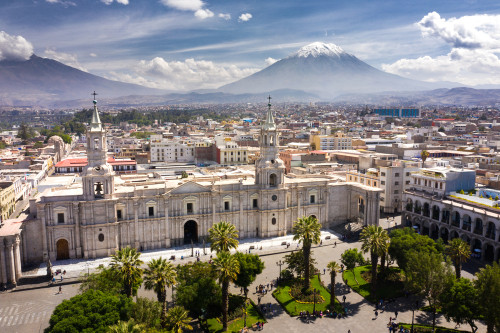
Most tourists are drawn to the “Gringo Trail” that links much of the country with Incan ruins at Machu Picchu, the Sacred Valley of the Incas, and the nearby city of Cusco (or Cuzco). Cusco combines big-city amenities with cobblestone roads, rolling hills, mountain vistas, and local arts and crafts. While this part of Peru is a must-visit destination for tourists, one place that should not be overlooked as a potential retirement destination is Arequipa, Peru’s second largest city. Arequipa enjoys a spring-like climate throughout the year and has an historic city center with beautiful 16th century Spanish architecture made of volcanic stone. The city center features a well-maintained plaza (one of the best in Latin America) and a beautiful monastery (Santa Catalina Monastery—considered to be a colonial architecture masterpiece), along with several interesting museums. Arequipa also has plenty of dining options and a night scene that includes bars serving craft beer, handcrafted Pisco cocktails, and local Peruvian wines. A short walk from the city center is the Cayma neighborhood, where there are modern shopping malls with sit-down restaurants, movie theaters, fast-food franchises like Starbucks, McDonalds, KFC, Popeyes, and Pizza Hut.
Outside the city there are several unique hiking and trekking opportunities that include volcanoes (El Misti is the most famous) and some of the deepest canyons in the world (Cotahuasi and Colca Canyon). Long-term visitors to Arequipa will want to spend time in the town of Chivay to explore Colca Canyon and the numerous small towns and traditional villages where daily life—and the surrounding natural landscapes—have not changed much over the years. For those craving a swim in the ocean, the coastal town of Mollendo is about a two-hour drive from Arequipa. And for those needing to make a quick escape back to the capital, there are several flights a day to Lima from Arequipa’s international airport. The flight, which takes about one and a half hours, is operated by LATAM Airlines using new Airbus A320 aircraft. There is also an international flight to Santiago, Chile on JetSmart Airlines.
Other Peruivian cities with potential as a retirement destination include several northern cities: Trujillo is known for its colonial architecture and nearby beachtown of Huanchaco; the bohemian beach town of Mancora and tranquil beaches in the Tumbes region that stretch north to the town of Zorritos—which have been given the nickname “the South American Caribbean”—are worth a look for those seeking a peaceful beach life (especially the small village of Punta Sal); the city of Piura, has a charming downtown, colonial buildings, and plenty of warm weather. Piura even has a shopping mall (Real Plaza) with a Starbucks and Longhorn Steakouse for those craving a taste of home; and Chiclayo is a lively city that also enjoys sunny, warm weather. Chiclayo is home to several colleges and universities, and there is a decent variety of restaurants and coffee shops here. The city is located about 20 minutes by car from Pimentel Beach, a popular place for locals to unwind and relax with family and friends. Another benefit to Chiclayo is its transporation options; there are several flights a day to Lima on LATAM Airlines, and Copa Airlines provides an international flight to Panama City (Panama) where connections can be made to the United States, Canada, Europe, and all throughout Latin America.
The Peru Retirement Visa Program
The visa system in Peru went through several major changes in mid-2021, and some programs are still being updated. Currently there are nine types of temporary visas and 18 residential visas available. The most popular option for retirees is the Rentista (retirement) visa program. The Rentista is available to those who no longer are employed in their home country. {If you want to work in Peru, you will need to obtain a work visa.} You will need at least $1,000 in monthly income to become eligible, plus another $500 for each dependent who will live with you in Peru. That income must originate outside of Peru and enter the country through a banking institution. Those funds can be generated from pension payments; permanent dividends from one or more companies; or bank assets that generate at least $1,000 in monthly interest. Further details on Rentista are available at https://www.gob.pe/12933-cambio-de-calidad-migratoria-residente-solicitar-cambio-de-calidad-migratoria-rentista-residente.
Unlike most other visas, the Rentista does not need to be renewed each year – although you do have to submit annual confirmation that you still live in Peru. Another significant benefit of the Rentista versus other visas is that you do not have to pay income tax on your pension. You can also import personal and domestic items without paying duties or taxes. However, one drawback for some people is the requirement that you must spend at least 183 days per year in Peru.
After you live in Peru for three years, you can apply for permanent residency. Also, spending a full two years in Peru, you can also apply for citizenship if you can demonstrate knowledge of the Spanish language and Peruvian culture. Peru allows dual citizenship, so you are not required to renounce your U.S. citizenship.
U.S. and Canadian passport holders do not need a visa to visit Peru for up to six months. This provides plenty of time to explore the country; decide whether you want to stay and where; and start the three-month visa process. While most major Peruvian cities have immigration offices, all visa applications are processed by the Superintendencia Nacional de Migraciones (https://www.gob.pe/migraciones) in Lima. Also be aware that there are few government employees who speak English, so unless you are fluent in Spanish, you may need to hire a bilingual agent or lawyer to help you work through the process.
The primary document you need to provide is certification of your permanent income from outside Peru. That certification must be legalized at a Peruvian consulate and accepted by the Ministry of Foreign Relations. All document submitted must either be written in Spanish or translated into Spanish by a Peruvian government-certified translator.
Other basic documents needed to obtain the Peru retirement visa are:
- Completed Form F-004 (Formulario F-004), available as a PDF at https://www.gob.pe/institucion/minam/informes-publicaciones/275346-formulario-f-04.
- Original U.S. passport plus a photocopy.
- Two passport-size photos.
- Apostilled (authenticated) marriage certificate and/or birth certificates of children for anyone included in the retirement visa.
- Police clearance certificate from your home country.
- Interpol International Exchange File, a policy clearance covering any country where you lived over the previous five years.
- Receipt showing payment of application fees. Visa application fees are just under $100.
The first step is obtaining a Carnet de Extranjeria (or CE, a foreign resident ID card) through Peruvian consulates in such cities as Atlanta, Miami, and Houston. The CE allows you to open a local bank account, purchase mobile phones and internet service, and travel within the country without your U.S. passport. Authentication of your documents will also take place at the consulate. You can forward your English and Spanish documents to the Peruvian government before you leave, but the approval process does not begin until you arrive in Peru. It normally takes two months for the government to approve the initial application, plus one to two more months for any dependents. Once you receive approval, you will have to pick up the retirement visa in person in Peru.
Residents of the United States with questions about obtaining a retirement visa for Peru -- or who would like us to help them ensure they have accumulated the necessary documents and paperwork before they travel to Peru -- can schedule a telephone call through our website or email Michael at michael@visasupply.com. We can also refer you to immigration attorneys, real estate agents, and personal drivers to help facilitate your initial trip to Peru.