

How to Obtain a Dominican Republic Retirement Visa
The Dominican Republic continues to grow its reputation as one of the world’s most popular retirement destinations. In 2022, Travel and Leisure magazine listed Dominican Republic as one of its top 10 global retirement destinations, with Travel + Leisure ranking it third internationally. “For a tropical island retirement, the Dominican Republic is one of the least expensive Latin American countries for retirees,” Travel and Leisure reported. The country’s appeal to North Americans is easy to understand, International Living added: “The climate is tropical, the lifestyle is easy-going and the beaches are beautiful. Only a two-hour flight from Miami, this is one of the Caribbean’s busiest tourist destinations.” (https://internationalliving.com/countries/dominican-republic/retire-to-the-dominican-republic/)
The Dominican Republic covers two-thirds of Hispaniola, the second largest island in the Caribbean. It is also the second-largest nation in the Antilles region by area and third-largest by population with 11 million people. Visited by Christopher Columbus on his 1492 voyage, the country was a Spanish colony until 1821. Decades of political turmoil and civil conflict followed until the Dominican Republic became a self-governing nation. “Since its 1844 independence from neighboring Haiti, the country has seen a mix of coups, U.S. military interventions and occupations, military government, and democratic government,” the U.S. State Department noted (https://www.state.gov/u-s-relations-with-the-dominican-republic). “The Dominican Republic has enjoyed peaceful transfers of power from one freely elected president to another since 1978.”
The country is also the most popular travel destination in the Caribbean and boasts the region’s second-largest economy. The nation has six international airports with direct flights to and from Atlanta, Miami, and other major cities in the Americas and Europe. More tourists come to the Dominican Republic from the United States than from any other country, with cultural interests ranging from baseball and music to local cigars and rums.
Living costs for retirees in Dominican Republic remain relatively low. “You can live well in the Dominican Republic on just US$1,355 a month (including many luxuries that you would have to do without on this same budget back home),” according to Live and Invest Overseas (https://www.liveandinvestoverseas.com/country-hub/dominican-republic/cost-of-living-in-the-dominican-republic/). “With a budget of $2,000, you could afford more entertainment and extra household help, for example, and really enjoy the good life.” Living costs in the capital city of Santa Domingo average 40% lower than those in Atlanta, with rents 59% less, according to Numbeo (https://www.numbeo.com).
Retirees are also drawn to the country’s healthy tropical lifestyle, biodiverse natural environments, modern healthcare system and ease of obtaining residency. While Spanish is the official language, many locals speak English, and there are large communities of American expats in the major cities. The country is politically and economically stable, although there are areas with high crime rates. Travel advisories from the U.S. State Department are frequently updated at https://travel.state.gov/content/travel/en/traveladvisories/traveladvisories/dominican-republic-travel-advisory.html.
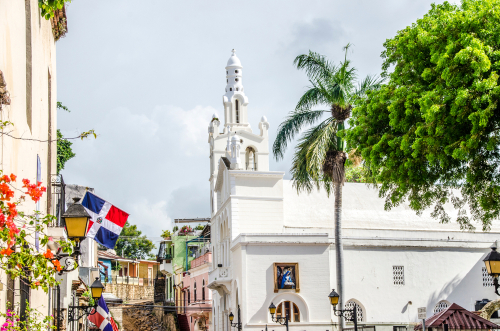
Most foreigners and retirees live in the nation’s two largest cities, Santa Domingo and Santiago. Santa Domingo, the largest metropolitan area in the Caribbean, is the cultural, financial, commercial, and political center of the country. This dynamic metropolis blends centuries-old architecture, large shopping malls, art galleries, vibrant nightlife, and diverse restaurants. The Colonial City—the first European settlement in the Americas and a UNESCO World Heritage Site—features a walkable maze of narrow streets that lead to colonial buildings, museums, shops, hotels, restaurants, and sidewalk cafés. Santiago, deep in the heart of the Cibao Valley, is another modern cosmopolitan center that pulsates with culture and history. The main landmark and social hub is Monumento a Los Héroes de la Restauració, while the nearby Cordillera Central mountain range offers a variety of hiking adventures. Cities such as Rio San Juan and Santo Domingo are also known for their growing number of American and European residents.
Other retirees favor the warm sandy beaches and resort communities along the Dominican Republic’s more than 1,000 miles of coastline. “Over 200 beaches—many of which remain uncrowded and undeveloped—line the Caribbean and the Atlantic coastlines, ranging from a brilliant white to a handful of black sand stretching southwest,” according to the Dominican Republic’s tourism website. World-renown beaches include Punta Cana’s 30-mile span; Playa Rincón and others on the Samaná Pensinsula; and north coast destinations such as Playa Cabarete, Playa Grande, and Playa Punta Rucia. Many retirees favor laid-back Sosúa and tranquil Barahona. Other beaches, such as Playa El Valle and Playa Frontón, can only be reached by boat. Casa de Campo is known for having the best golf resort in the world. Other outdoor diversions include snorkeling, scuba diving, mountain biking, hiking forest trails, paragliding, ziplining, caving, climbing/rappelling, and horseback riding.
Dominican Republic Residency Visa Programs
Citizens of the United States who hold a passport valid for at least six months do not need a visa to visit Dominican Republic for stays lasting up to 30 days. However, you will need to purchase a $10 tourist card when you arrive at the airport. All COVID-19 travel restrictions were discontinued in April 2022, making visits easier.
The Dominican Republic offers several types of residency visas, including investors, family reunification, and pensionado (pension/retirement), listed at https://drembassyusa.org/visas/visa-de-residencia-rs/. The pensioner visa is available to applicants who can prove they receive at least $1,500 in monthly income ($1,750 for couples) from a foreign government or private pension.
The first step towards retiring in the republic is obtaining a residence visa. This visa is valid for 60 days and allows one entry to the country. You must apply online or through a Dominican Republic embassy or consulate. The residence visa fee is $90.
After arrival, the next step is to appear before the General Directorate of Immigration within 60 days to complete the application process for a provisional residency permit. (You can also apply through the government’s portal, upload copies of the necessary documents in .jpg format, and pay your fee.) It typically takes 45 days to process the application, although it can take up to six months. After your permit is approved, you can obtain a permanent residency permit that must be renewed periodically until you have lived in the country for several years. You can also apply for naturalization after two years, a process that usually takes 12 months. Seniors retiring in the republic can often speed up the process of obtaining permanent residency.
Documentation to apply for the retirement visa includes:
- Your residency visa.
- Completed application (available at http://consuladord.com/es/formulario.aspx).
- Birth certificate.
- Four passport-style photographs.
- Certification from your home country that you have a clean criminal record.
- Financial documentation, such as certified proof of your U.S. pension source.
- Certificate from a Dominican Bank where you have opened an account.
- Marriage certificate, proof that a couple has lived together, or a declaration that you are single.
- Travel insurance policy obtained through a government-authorized insurer.
- Medication examination from a government-authorized institution after arrival to demonstrate you do not have any contagious diseases.
All documents must be translated into Spanish. Both the originals and translations must be notarized.
If you prefer to apply for a retirement visa before leaving the United States, you will need to go through the Dominican Republic’s embassy in Washington, D.C., or through a consulate. There are consulates in Miami, New Orleans, and several other cities across the country, as listed at http://www.domrep.org/consulates_us.html.
You can also use a courier service such as Visa Supply to deliver your paperwork to the embassy/consulate and retrieve your visa for an additional charge. Residents of the United States with questions about obtaining a retirement visa for the Dominican Republic -- or who would like us to help them ensure they have accumulated the necessary documents and paperwork before they travel -- can schedule a telephone call through our website or email Michael at michael@visasupply.com. We can also refer you to immigration attorneys, real estate agents, and personal drivers to help facilitate your initial trip to the Dominican Republic.