

How to Apply for a Korea Working Holiday Visa
South Korea’s working holiday visa program allows young Americans to spend up to 18 months in the “Land of the Morning Calm.” Applicants ages 18 through 30 are eligible for the special visa, which allows them to work temporarily and/or study at a South Korean school.
The H-1 (working holiday) visa allows visitors to enter and re-enter as many times as they wish during the visa period. This allows these visitors to travel to neighboring Asian countries or come back to the United States to visit their families without affecting the visa period.
Citizens from some 25 countries can apply for the Working Holiday Program (WHP). U.S. applicants can stay for 18 months after entering South Korea, but most other countries’ citizens are limited to 12 months) The annual quota for U.S. participants is 5,000 visas. U.S. participants must also be enrolled in a post-secondary institution or have graduated within the past year to be eligible for WHP.
According to the South Korean government, tourism cannot be the main purpose for the visit (although the program allows plenty of time for sight-seeing). Students are only allowed to take classes offered in the Korean language. There are also employment restrictions, as listed on the website for the South Korean embassy in Atlanta (https://overseas.mofa.go.kr/us-atlanta-en/wpge/m_4858/contents.do). For example, WHP holders may not be employed as receptionists, dancers, singers, acrobats, adult entertainers, doctors, lawyers, pilots, teachers, reporters, journalists, or researchers.
Touring South Korea
In recent decades, South Korea has evolved into one of the leading economic and cultural centers in Asia. More than 17.5 million visitors arrived in the nation during 2019, the fourth consecutive year of double-digit increases. However, that total plummeted to only 2.5 million during the COVID-19 pandemic restrictions of 2020.
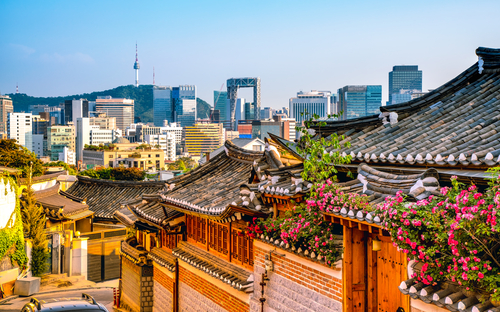
The primary destination for foreign visitors is the capital city of Seoul, where traditional Korean culture co-exists with a modern metropolitan atmosphere. Five palace complexes have been restored in the city, including Gyeongbokgung Palace, site of the National Palace Museum of Korea and the National Folk Museum. Nearby Bukchon Hanok Village recreates life in South Korea 600 years ago. Ride the cable car to the top of Seoul Tower on Mount Namsan for panoramic views of the area. More than one-third of South Korea’s cultural activities are found in Seoul, including live performances, the National Museum of Korea, and Seoul Museum of Art. The city also offers Western shopping complexes, traditional markets, upscale dining, and street food such as Korean barbeque.
On the southeastern coast, the second largest city, Busan, draws visitors to its hot springs and beaches. Visitors to Beomeosa Temple, a Buddhist shrine dating back more than 1300 years, offers a temple stay program for visitors. Haedong Yonggung Temple is one of the few temples in South Korea that overlooks the sea. Other popular attractions include the Lantern Festival at Samgwangsa Temple, the coastal walkway Taejongdae Resort Park, and hiking to the Cliff Carvings of Seokbulsa. Busan also boasts the largest shopping mall in the world and the country’s largest spa.
South Korea also offers a wide variety of natural environments, from the rugged beaches on the southeastern coast to mountains that cover 70 percent of the country. The largest island in South Korea, Jeju Island, is known for its volcanic landscapes, lava tubes, and beach resorts. Hike to the top of the World Heritage Site of Seongsan Ilchulbong for sweeping views of its crater and the ocean coast. Seoraksan National Park in Sokcho is home to thousands of specials of rare plants and animals, as well as black bears and Siberian flying squirrels. Manjanggul Cave stretches eight miles into the earth, sheltering wildlife and unique volcanic rock formations.
The cost of living in South Korean is almost 10% higher than the United States, according to Numbeo (https://www.numbeo.com/cost-of-living/country_result.jsp?country=South+Korea). However, rents are 40% lower than U.S. housing costs, the report noted.
Applying for the South Korean Working Holiday Visa
An online application form and current information for the WHP visa can be found at the South Korean embassy web site for the United States (https://overseas.mofa.go.kr/us-en/brd/m_4502/view.do?seq=715727&srchFr=&%3BsrchTo=&%3BsrchWord=&%3BsrchTp=&%3Bmulti_itm_seq=0&%3Bitm_seq_1=0&%3Bitm_seq_2=0&%3Bcompany_cd=&%3Bcompany_nm=). You must apply through your local embassy or consulate at least 90 days before you plan to start your visit. Processing typically takes about 2 weeks. If your application is granted, you will have up to 12 months to enter South Korea, after which you can stay for 18 months.
Basic requirements include:
- Valid U.S. passport.
- Between the ages 18 and 30 at the time of application.
- Cannot be accompanied by dependent children.
- Have not previously participated in WHP.
- Be enrolled in a post-secondary school or graduated within the last 12 months.
- KRW 3,000,000 (about $2,700 U.S.) in funds in a bank account to support yourself during your first six months -- above and beyond any wages you may earn.
- Have a return plane ticket or funds to buy one.
In addition to your application, you will also need to submit:
- Application fee of $45.
- Two passport photos.
- Financial documentation
- Proof of medical insurance.
- Copy of return plane ticket (or document funds to buy one).
- College transcript or diploma.
- Travel plans.
- Criminal background check.
- Medical examination.
For more information about the South Korean Working Holiday visa -- or about other working holiday visa programs in other countries -- contact Michael at Visa Supply by email at michael@visasupply.com.